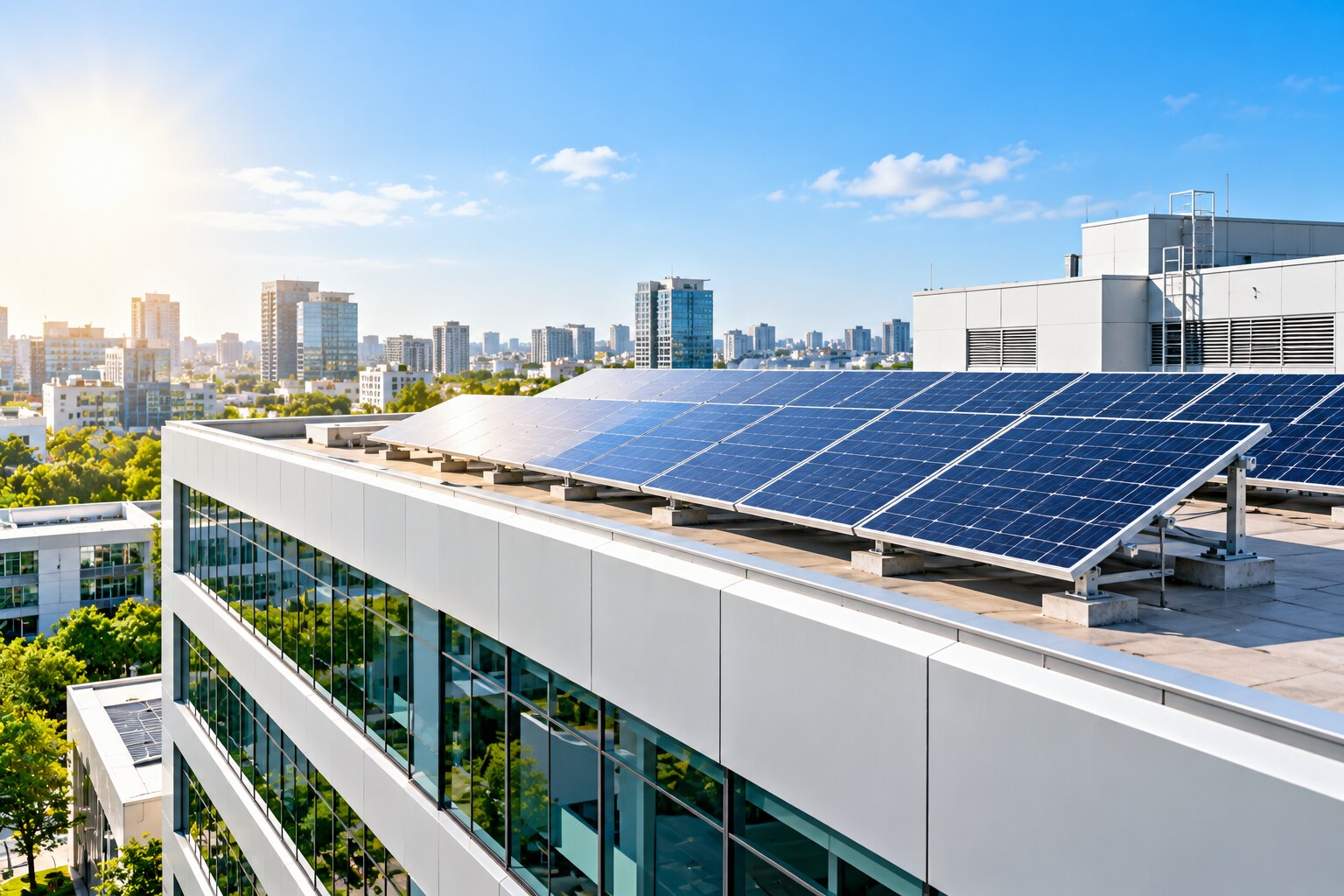
Solar reduces an office’s purchased electricity only while the panels are producing, so the strongest financial case comes from matching generation with the building’s hourly demand and tariff structure. By the end, you can estimate the offset, size the system, test alternatives, compare proposals, and identify the operational conditions that determine whether the investment will pay back.
Key takeaways
- Compare hourly office demand with solar output, not annual electricity use alone.
- Size the array using daytime load, usable roof area, and export limits.
- Model self-consumption, export credits, battery costs, and payback together.
- Check approvals, warranties, safety controls, and installation disruption before signing.
Match Solar Generation to the Office’s Real Electricity Bill
Rooftop solar can reduce the portion of an office bill tied to solar-producing hours, not the entire bill. Compare the daytime load profile with 12 months of electricity bills: hourly consumption and solar output matter more than annual kWh totals. High self-consumption produces greater savings than exporting surplus at a lower credit.
Match the office’s daytime loads to solar production:
- Air-conditioning usually aligns well with late-morning and afternoon generation, provided the building operates then.
- Lighting and office equipment add steady daytime demand that solar can serve directly.
- Servers run through the night, so solar offsets only their daytime consumption unless batteries shift energy.
- Lifts and pumps create short or irregular peaks; solar helps only when those peaks coincide with adequate output.
Read every bill line before estimating savings. Separate:
- Energy charges: the kWh solar can directly replace.
- Demand charges: charges based on maximum demand during a billing interval; solar reduces them only if it lowers that interval’s peak.
- Fixed charges: amounts that remain after consumption falls.
- Time-of-day charges: rates that change by hour, making midday solar more or less valuable.
- Taxes, wheeling charges, and banking charges: additional amounts that can remain payable or apply to exported energy.
A cloudy interval, evening peak, or export limit can leave demand charges largely unchanged. Use the bills to calculate the daytime kWh solar can serve, then value exported energy separately; do not treat annual generation as equal to annual bill savings.
Size the Array Around Load, Roof, and Export Limits
Do not size the array from annual kWh alone. Start with sanctioned load, 12 months of monthly kWh consumption, and an interval or hourly profile showing daytime consumption. Solar offsets electricity while it produces, so loads such as air-conditioning, lifts, pumps, lighting, servers, and office equipment matter more than evening demand.
- Calculate usable roof area from shadow-free space, excluding parapets, water tanks, HVAC equipment, fire access paths, and required maintenance clearances. Preserve drainage routes; blocked outlets create leaks.
- Check structural capacity before choosing modules. An engineer must verify slab capacity or sheet capacity, mounting loads, wind exposure, corrosion risk, waterproofing details, and the roof warranty. A roof replacement due soon can make removal and reinstallation more expensive than a smaller array.
- Build a site-specific generation model using orientation, shading, weather, module layout, and hourly load. Set DC capacity against AC inverter output: deliberate oversizing can improve annual yield, but clipping occurs when panel output exceeds inverter capacity.
| Constraint | What to verify | Why it limits size |
|---|---|---|
| Sanctioned load | Inverter rating, protection, and interconnection against the sanctioned load | A utility may reject a design that exceeds approved demand |
| Roof | Shadow-free space, structural capacity, drainage, access, and warranty conditions | Fewer safe modules reduce installable capacity |
| Grid export | Export limit, metering arrangement, and required export-control equipment | Surplus generation can trigger upgrades or approval delays |
Submit the model, single-line diagram, protection settings, and export-control plan before treating an installation date as firm. Size below the strictest limit, not the largest roof measurement.
Test the Financial Case Before Choosing Solar or Batteries
Use the tariff, not the panel count, to choose the highest-value investment. Compare the retail energy rate with the export compensation offered through net billing, an avoided-cost rate, or a time-varying tariff. An export cap can make additional panels worthless once the allowed limit is reached.
A worked self-consumption example: an office uses 1,000 kWh during sunny hours, and a proposed array produces 1,200 kWh then. If it supplies 800 kWh directly, that energy earns the retail rate; the remaining 400 kWh earns export compensation.
Adding battery storage makes sense only if the later discharge value exceeds round-trip losses, battery degradation, controls, and replacement costs.
| Option | Best value when | Main financial test |
|---|---|---|
| Solar used on site | Daytime loads are steady | Retail savings versus capital cost |
| Solar exported | Surplus receives a strong rate | Export compensation after the export cap |
| Battery storage | Evening use or demand peaks follow solar hours | Demand-peak reduction plus shifted-energy savings |
| Efficiency project | Loads can be cut permanently | LED retrofit, HVAC optimisation, building-management controls, or power-factor correction cost less per saved kWh |
Model 12 months of bills with the revised electricity tariff, financing interest, operations and maintenance, inverter replacement, insurance, cleaning, degradation, and downtime. For an owner-occupied building, solar often beats export-only economics; a leased office needs a shorter payback, while a rented roof may favour a third-party power-purchase arrangement.
Fund efficiency first when it delivers cheaper, more certain savings than panels or batteries.
Compare Proposals, Approvals, and Installation Disruption
Require a line-item proposal, not a single price. Compare panel wattage, panel technology, inverter type, string design, monitoring, and whether a revenue-grade meter verifies production and exports.
| Proposal item | Require in writing | Risk if missing |
|---|---|---|
| Generation model | Generation assumptions by month, degradation assumptions, recent bills used, and exclusions; show how Maharashtra tariff changes and net-metering rules affect savings | Attractive annual output can hide weak daytime savings |
| Ownership and cover | Roof ownership, roof permission, product warranty, workmanship warranty, cleaning responsibility, annual maintenance, inverter repair terms, and replacement costs | A roof dispute or separate inverter failure becomes your expense |
| Approvals and build | Approval timeline, utility application, net-metering agreement, meter replacement, cable routes, inverter placement, shutdown planning, crane access, material handling, and commissioning time | Installation can interrupt office operations or wait on the utility |
Before approval, require these documents:
- The sanctioned-load document, single-line diagram, electrical drawings, structural report, roof layout, and protection scheme. Ask the supplier to identify every assumption and exclusion in the design.
- A dated programme showing survey, utility approval, equipment delivery, shutdown windows, installation, testing, and commissioning. SunsetLife Solar Pvt. Ltd should explain which dates depend on the utility rather than promise an installation date it cannot control.
- A disruption plan naming affected circuits, maximum shutdown duration, temporary power arrangements, worker access routes, lift or parking restrictions, and who authorises isolation. Require written acceptance of the final cable routes and inverter placement before material arrives.
Related products
 | Commercial Solar Rooftop System Commercial Solar Rooftop System The Commercial Solar Rooftop System is a cost-effective solution for offices, shops, malls, hospitals, schools, and commercial buildings. View product → |
 | Hybrid Solar Power System Hybrid Solar Power Systems combine the benefits of on-grid and off-grid solutions. View product → |
Operate and Verify the System Without Endangering Office Loads
Treat commissioning as the start of operating control: a productive rooftop system stays tied to measured performance. Review inverter data weekly and compare expected-versus-actual generation monthly.
Investigate a persistent shortfall for soiling, shade, outages, or faulty equipment; set alarms and contract a defined fault response time so a failed inverter does not quietly erase daytime savings.
Use a written maintenance plan:
- Schedule module cleaning from measured soiling, not a calendar alone; inspect drainage and roof penetrations during each visit.
- Maintain vegetation control and shade control; trim growth before it reaches modules or blocks fire access.
- Require safe access, DC isolation, earthing, lightning protection, electrical protection, and thermal scanning during electrical inspection; record inverter servicing and repairs.
Before energising the array, verify cable routes, electrical-panel capacity, and protection settings against the building design. Test emergency shutdown and document arc-fault risk controls so responders are not forced across live equipment.
Confirm compatibility with each critical building interface:
- Diesel generator and automatic transfer switch: test anti-islanding and transfer sequencing.
- UPS, elevators, data rooms, and other sensitive loads: test voltage, frequency, and restart behaviour.
- Spare inverter capacity: include it only when justified by expansion plans and budget.
Record baseline production and service costs. That lets you weigh environmental benefit against direct financial benefit without hiding maintenance risk.
Frequently asked questions
How do you match solar generation to an office electricity bill?
Compare 12 months of bills with interval or hourly demand data, focusing on electricity used during solar-producing hours. Solar saves more when the office consumes the generation directly instead of exporting surplus.
How should you size a solar array for an office building?
Use the daytime load profile, usable roof area, structural constraints, inverter capacity, local export limits, and the office’s future electricity demand. Annual consumption alone cannot determine the right system size.
Should an office choose solar panels, batteries, or both?
Compare the value of daytime self-consumption and exported energy with battery purchase, replacement, financing, and maintenance costs. Batteries deserve closer analysis when valuable loads continue after sunset or export limits restrict solar output.
What should you compare in office solar proposals?
Compare panel and inverter specifications, production assumptions, warranties, monitoring, approvals, grid-connection responsibilities, safety provisions, payment terms, and the installation schedule. Ask how contractors will protect office operations during electrical work.
Related products
 | On-Grid Solar Power System On-Grid Solar Power Systems are connected to the electricity grid, allowing users to export excess power and benefit from net metering. View product → |
 | Off-Grid Solar Power System Off-Grid Solar Power Systems operate independently from the utility grid and include battery storage. View product → |