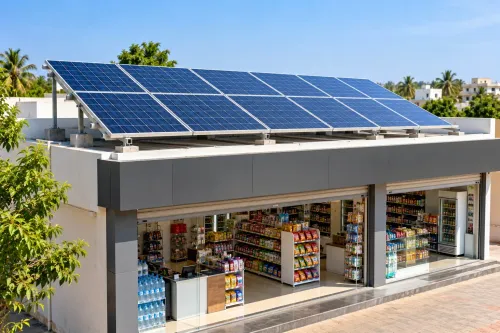

Solar lowers a commercial electricity bill only when its generation matches the site’s expensive consumption and the utility credits exported power fairly. By the end, you can model savings from 12 months of bills, test payback and investment returns, compare solar with other upgrades, and identify the approvals that affect the final result.
Key takeaways
- Use 12 months of bills and interval data before estimating savings.
- Size panels around operating hours and daytime electricity consumption.
- Model demand charges, tariffs, exports, fixed charges, taxes, and future bills.
- Compare solar with efficiency upgrades and contract-based electricity supply.
Build the bill model before estimating solar savings
A credible commercial solar cost model compares each future year with the no-solar bill, not installation cost divided by first-year savings. Start with 12 months of bills and interval data: record kWh, tariff, demand charges, fixed charges, taxes, operating hours, and the share consumed while panels generate.
1. Estimate output from system capacity and annual generation, then reduce it for module degradation. Split production into self-consumed kWh and exports; value each at its actual retail tariff or export credit.
2. Build annual solar costs: maintenance, monitoring, insurance, financing, taxes, inverter replacement, roof removal and reinstallation, and final removal or residual value. Add battery controls, thermal management and replacement if storage is included.
3. Calculate annual net cash flow as avoided bill plus export credit minus these costs. Include tariff escalation and demand-charge savings only when solar output coincides with the facility’s demand peak; solar does not normally eliminate fixed charges.
4. Discount each cash flow to today. Report the solar payback period, internal rate of return, net present value (NPV), and lifetime electricity cost against the no-solar case.
A larger array can perform worse financially when it exports heavily at a low credit rate. Check the roof’s remaining life before accepting the model: replacement during the project can add dismantling, permitting, reinstallation and downtime costs. Choose the design with positive NPV under realistic output, tariff and maintenance assumptions.
Size the system around actual operating patterns
A system sized from roof area alone can produce impressive annual output and weak savings. Start with a commercial load profile: compare electricity use during solar-generating hours with evening and overnight consumption, then check weekday, weekend and seasonal patterns.
Ask the designer to size from these site records and constraints:
- 12 months of electricity bills, including tariff category, monthly units, fixed charges and recorded demand
- Sanctioned load and maximum demand, checked against the proposed inverter capacity and the utility connection
- Interval or 15-minute meter data, where available, to show whether solar production overlaps with the facility’s real operating load
- Operating hours, shift changes, shutdown periods and future expansion plans
- Usable roof area after walkways, fire access, equipment clearances, water tanks and maintenance space
- Roof orientation, tilt, shading from nearby buildings or trees, and obstructions that reduce the array’s productive area
- Roof age, waterproofing condition, remaining service life and planned replacement date
- Structural capacity for module and mounting dead load, wind uplift, seismic forces and attachment locations under local building-code requirements
A brief late-afternoon peak can remain the site’s maximum demand even when panels generate heavily earlier in the day. If the roof needs replacement during the solar system’s life, removal and reinstallation costs can erase savings; a smaller array with higher on-site consumption may be the sounder design.
Match generation to demand charges, tariffs and export rules
A larger array is not automatically a cheaper one. If your business consumes little electricity while panels are producing, the system may export much of its output at a credit below the retail rate. A smaller array with higher self-consumption can produce better savings and payback.
| Electricity use | Bill impact | What to check |
|---|---|---|
| On-site solar use | Usually offsets the applicable retail energy charge | Match output with operating hours |
| Exported solar | Earns the rate allowed under your agreement | Confirm net metering, export limits and credit treatment |
| Grid power during expensive periods | Still attracts the prevailing tariff and demand charges | Review 15-minute or 30-minute interval peaks |
Time-of-use tariffs make timing decisive. Solar generated during a low-price period has less value than solar that replaces electricity during an expensive afternoon period, while a late-evening peak receives no direct benefit from daytime generation.
Rooftop PV does not automatically remove demand charges. The utility calculates these from the facility’s interval peak, so one brief evening surge can leave the charge unchanged despite strong monthly solar production.
A battery can shift stored solar into that peak, but include its purchase cost, controls, thermal management, maintenance and eventual replacement before counting the saving.
Ask the installer to model hourly or interval consumption, generation, export credits and demand charges under your actual tariff. Check whether net metering applies to your connection and whether the utility imposes an export cap or requires metering and protection changes. These rules can turn surplus generation into a weak financial return.
Compare solar with efficiency upgrades and contract-based supply
Rooftop solar is the better cost-control investment when the facility uses substantial electricity during daylight, has a sound roof with many years of life remaining, and can consume most generation on site. It becomes less attractive when export compensation is low, night-time demand dominates, or cheaper efficiency work can remove the load first.
| Option | Main cost lever | Better choice when | Main limitation |
|---|---|---|---|
| LED retrofit | Cuts lighting kilowatt-hours | Lighting runs for long shifts | Does not reduce process or cooling loads |
| HVAC efficiency | Reduces cooling demand and peak load | Air-conditioning drives summer bills | Requires equipment and controls work |
| Power-factor correction | Reduces penalty charges and apparent demand | Bills show poor power factor | Does not materially cut energy use |
| Rooftop solar | Replaces purchased daytime energy | On-site consumption is high and roof work is limited | Output varies; inverters, monitoring and maintenance add costs |
| Open-access renewable power | Buys renewable energy without owning a roof system | Roof capacity is inadequate or capital is restricted | Wheeling, banking, surcharge and contract terms affect the landed price |
| Power-purchase agreement | Avoids most upfront capital | Predictable contracted supply matters more than ownership | Escalators, minimum payments and transfer clauses reduce flexibility |
Compare these choices through one cash-flow model, not installation cost divided by first-year savings. Include tariff escalation, module degradation, maintenance, insurance, inverter replacement, financing, taxes, export credits and roof work. Add battery costs only when shifting solar into demand-charge or time-of-use periods produces more savings than storage, controls and future replacement consume.
Check roof life, approvals and proposal quality before committing
A roof replacement during the solar system’s service life can erase projected savings: removing panels, repairing the roof and reinstalling the array adds labour, permits and lost-generation downtime. Obtain a structural assessment covering dead load, wind uplift, seismic forces, attachment points and roof condition before accepting the design.
Request these documents and assumptions before comparing proposals:
- The latest 12 months of bills, sanctioned load and maximum demand
- A single-line diagram showing the proposed inverter, protection, isolators, meter and point of interconnection
- The MSEDCL or BEST application path, export limit, metering requirement and written approval status
- The tariff used for self-consumed energy, exported energy, demand charges and taxes
- Equipment-replacement, degradation, insurance, maintenance and roof-work allowances
| Check | Evidence to compare | How it can change savings |
|---|---|---|
| Roof | Structural assessment and remaining roof life | Early reroofing adds removal, storage and reinstallation costs |
| Grid connection | MSEDCL or BEST approval, protection study and metering scope | Feeder or transformer upgrades can add cost and delay operation |
| Export | Written export limit and credit rate | Excess generation may earn less than on-site consumption |
| Financial model | Year-by-year cash flow, not simple payback | Tariff changes, inverter replacement, financing and taxes alter returns |
A credible proposal names who pays for utility upgrades and includes a commissioning date tied to approvals. SunsetLife Solar Pvt. Ltd can be evaluated on whether its commercial proposal supplies these drawings, assumptions and approval responsibilities rather than presenting only panel capacity and first-year savings.
Related products
 | Commercial Solar Rooftop System Commercial Solar Rooftop System The Commercial Solar Rooftop System is a cost-effective solution for offices, shops, malls, hospitals, schools, and commercial buildings. View product → |
 | Solar Panel Installation Solar Panel Installation Services We provide end-to-end Solar Panel Installation Services, including site survey, system design, installation, testing, and commissioning. View product → |
Frequently asked questions
What data do you need to estimate commercial solar savings?
Collect 12 months of electricity bills and interval data showing kWh, tariff rates, demand charges, fixed charges, taxes, operating hours, and daytime consumption.
How should you size a commercial solar system?
Match system output to actual operating patterns, especially the electricity your business uses while the panels are generating. Avoid sizing from roof area alone.
Why do demand charges and export rules affect solar savings?
Solar can reduce grid energy purchases, but savings also depend on peak demand charges, tariff structures, export compensation, and limits on sending surplus power to the grid.
What should you check before accepting a commercial solar proposal?
Review roof life, structural suitability, permits and utility approvals, equipment assumptions, production estimates, maintenance terms, warranties, and the proposal’s comparison with your no-solar bill.
Related product
 | Industrial Solar System Our Industrial Solar Power Plants are designed for factories, warehouses, and large-scale manufacturing units. View product → |