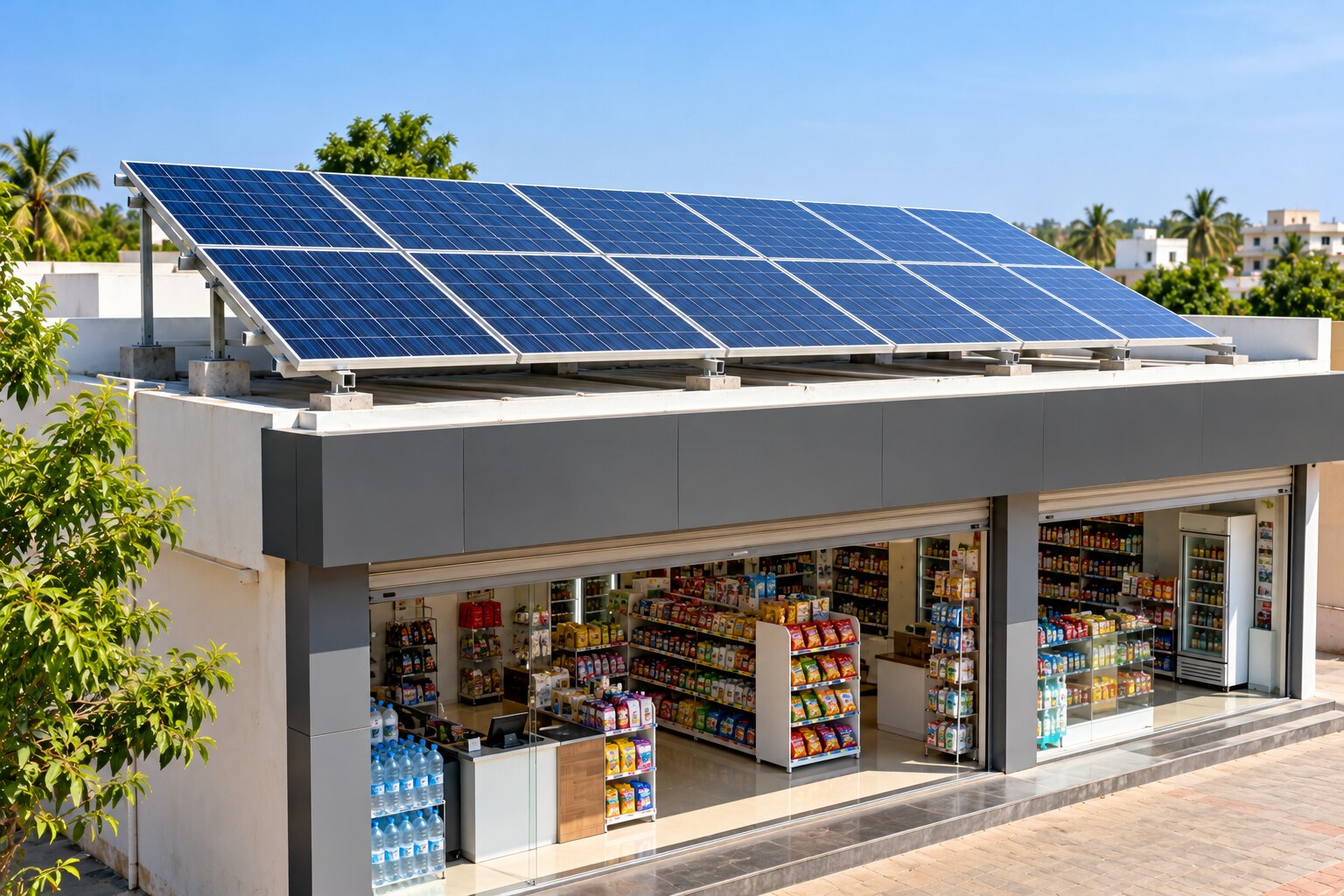
A lower electricity bill depends on more than the number of panels on your roof. By matching solar production with your shop’s daytime loads, tariff structure, export rules and usable roof area, you can estimate realistic savings and avoid paying for capacity that produces little financial benefit.
Key takeaways
- Use 12 months of billing units before sizing a shop solar system.
- Match capacity to daytime consumption, not available roof area alone.
- Compare net metering, gross metering and applicable credit arrangements.
- Judge proposals by total lifetime cost, warranty and expected savings.
Start with the electricity bill, not the roof size
Take the last 12 months of your Maharashtra electricity bill and record the billing units for each month. Do not divide the total bill by the roof area. Solar savings depend on the energy charge that solar can replace, not on the entire amount payable.
Separate each bill into these parts:
- Energy charges calculated from billing units and tariff slabs
- Fixed charges for the connection or sanctioned load
- Demand charges, if the tariff includes them
- Electricity duty, taxes, and other levies
- Credits or adjustments for exported electricity
Next, estimate the solar energy your shop will use during operating hours. Subtract exported units from total generation to find self-consumed units. Your basic monthly saving is:
Self-consumed units × applicable retail energy rate + exported units × approved export credit
Use each tariff slab rather than one average rate when the solar reduction moves your consumption into a lower slab. Check the applicable Maharashtra electricity bill tariff and export rules before using the calculation.
For example, a system producing 600 units in a month might supply 450 units directly to refrigerators, air-conditioners, lighting, and billing equipment while the shop is open. The remaining 150 units could receive an export credit, but fixed charges, demand charges, taxes, and connection fees would still remain.
Compare the revised bill with the original bill for the same month. A proposal showing annual generation alone cannot tell you the amount you will actually save.
Match system capacity to the shop’s daytime load
Size the system around the electricity your shop uses while the sun is up, not around total annual consumption. Your daytime load profile determines how much solar power you can use directly and how much would be exported at a possibly lower credit.
Record each appliance’s rated watts or kilowatts, operating hours, and busiest simultaneous period. Include the shop’s sanctioned electrical load and allow for seasonal changes: air conditioners run hardest in hot months, while refrigerators operate throughout the day and night. This is the basis of commercial solar sizing.
| Shop load or pattern | What to record | Sizing implication |
|---|---|---|
| Refrigerators and freezers | Running hours, compressor cycling, night consumption | Strong daytime self-use; do not size for their full 24-hour energy demand |
| Air conditioners | Unit capacity, hours, thermostat setting, summer peak | Increase daytime consumption and may set the inverter’s midday operating target |
| Lighting, signage and exhaust fans | Opening hours and switch-on schedule | Useful daytime loads; separate late-evening signage from solar production |
| Computers, billing and POS equipment | Number of devices and operating hours | Predictable daytime demand with little start-up surge |
| Cooking or workshop equipment | Power rating and use periods | Check whether machines run together and exceed the inverter output |
| Shops opening late or closing at noon | Actual solar-hour operation | Lower self-consumption; a smaller system or approved export arrangement may make more sense |
Use the highest regular simultaneous load to check inverter capacity, then compare it with roof area, solar resource and export limits. A grid-tied system will not keep these appliances running during an outage without batteries and backup controls.
Check the roof and choose the right credit arrangement
A 5 kW array saves money only when the shop has enough usable roof area and daytime demand to use its output. Measure the shadow-free roof, excluding water tanks, access paths, parapets and unsafe sections. Complete structural checks and waterproofing repairs first; removing panels for a roof replacement can erase several years of savings.
| Arrangement | How the bill is credited | Check before choosing |
|---|---|---|
| Net metering | Solar offsets live consumption; surplus units flow to the grid and receive an approved credit | Export limit, settlement period, meter charges and sanctioned load |
| Gross metering | All generated units go to the grid; the utility pays the approved generation rate | Purchase rate, payment schedule and whether shop consumption is billed separately |
| Self-consumption without export | Solar serves connected appliances, but unused generation is curtailed | Daytime load, inverter controls and permission to connect the system |
Net metering is usually more valuable when refrigerators, air-conditioners, lighting or computers run during daylight, because self-used units avoid the retail tariff. Gross metering can suit a shop with little daytime consumption, but its generation rate may be below the tariff you pay.
Ask the utility for its current export rules, time-of-use rates, demand charges and fixed charges; solar usually reduces energy charges, not every line on the bill. Confirm that the proposed capacity fits the sanctioned electrical load. A grid-tied system also shuts down during an outage, so backup equipment is a separate requirement.
Use a worked example to estimate monthly savings
Assume a shop uses 3,000 kWh per month and pays ₹10 per grid unit. Its bill also includes ₹1,500 in fixed charges and ₹2,000 in demand charges.
A 20 kW rooftop system produces 2,400 kWh monthly: the shop uses 1,800 kWh through daytime refrigeration, air-conditioning and lighting, while 600 kWh becomes exported electricity credited at ₹4 per unit.
| Calculation | Amount |
|---|---|
| Energy avoided through self-consumption: 1,800 × ₹10 | ₹18,000 |
| Export credit: 600 × ₹4 | ₹2,400 |
| Monthly bill savings | ₹20,400 |
| Revised bill: 1,200 imported units × ₹10 + ₹1,500 fixed + ₹2,000 demand − ₹2,400 credit | ₹13,100 |
The original bill was ₹33,500, so the estimated monthly bill savings is ₹20,400 before taxes and other adjustments. Fixed charges and demand charges remain; solar does not erase them unless the tariff rules and measured peak demand change.
If the installed price is ₹18 lakh, annual savings of ₹2,44,800 produce a simple solar payback of about 7.4 years. Subtract annual maintenance, insurance, financing interest and a future inverter replacement reserve before relying on that figure. Export limits or a lower credit rate will lengthen it.
SunsetLife Solar Pvt. Ltd can make this estimate more reliable by using the shop’s hourly load, sanctioned demand and utility export rate rather than its annual consumption alone.
Related products
 | Solar Panel Installation Solar Panel Installation Services We provide end-to-end Solar Panel Installation Services, including site survey, system design, installation, testing, and commissioning. View product → |
 | Commercial Solar Rooftop System Commercial Solar Rooftop System The Commercial Solar Rooftop System is a cost-effective solution for offices, shops, malls, hospitals, schools, and commercial buildings. View product → |
Compare the proposal on lifetime cost, not annual generation
Approve the quote only after converting its promised generation into lifetime bill savings. Include the installed price, financing interest, insurance, cleaning, monitoring, repairs, inverter replacement and roof-related work. Subtract panel degradation from later-year output, and check whether the quoted solar performance ratio includes heat, soiling, shading, wiring and inverter losses.
| Item | What to check | Why it changes lifetime cost |
|---|---|---|
| Tariff | Time-of-use rates, demand charges, fixed charges, taxes and export compensation | High generation does not guarantee lower peak-demand or total bills |
| Roof | Waterproofing, structural capacity and remaining roof life | Repairs can require array removal, reinstallation and business downtime |
| Output | Location-specific simulation, loss budget and panel degradation assumption | Nameplate capacity is not continuous delivered power |
| Battery backup | Usable capacity, conversion losses, thermal management, warranty and replacement cost | It pays off through outage protection, peak avoidance or export limits—not automatically |
| Maintenance | Cleaning access, monitoring, fault response, insurance and inverter replacement | Small recurring costs compound over the system’s life |
Ask for monthly production and savings estimates, not one annual figure. Test them against your shop’s daytime load, sanctioned electrical load and export limit. A battery that shifts energy into evening hours can still fail financially if export credits are generous and outages are rare.
Confirm which bill items remain after installation: connection charges, minimum charges, demand charges and taxes often survive reduced energy consumption. Also obtain the inverter model, replacement assumption, panel warranty terms and a written responsibility for roof leaks before signing.
Frequently asked questions
Why should you start with the electricity bill instead of roof size?
Record the billing units from each of the last 12 months. Solar savings depend on the energy charge that solar replaces, not the total bill or roof area.
How do you match solar capacity to a shop’s daytime load?
Review consumption during shop operating hours and size the system around the electricity used then. A system that exceeds daytime demand may export more energy and deliver less immediate bill reduction.
What should you check before installing panels on a shop roof?
Check roof strength, usable shadow-free area, access for installation and maintenance, wiring routes, meter location and the credit arrangement available for exported electricity.
How should you compare solar proposals for a shop?
Compare installed price, expected generation, replacement costs, warranties, maintenance, financing, export credits and total lifetime cost rather than annual generation alone.
Related products
 | On-Grid Solar Power System On-Grid Solar Power Systems are connected to the electricity grid, allowing users to export excess power and benefit from net metering. View product → |
 | Off-Grid Solar Power System Off-Grid Solar Power Systems operate independently from the utility grid and include battery storage. View product → |